Introduction
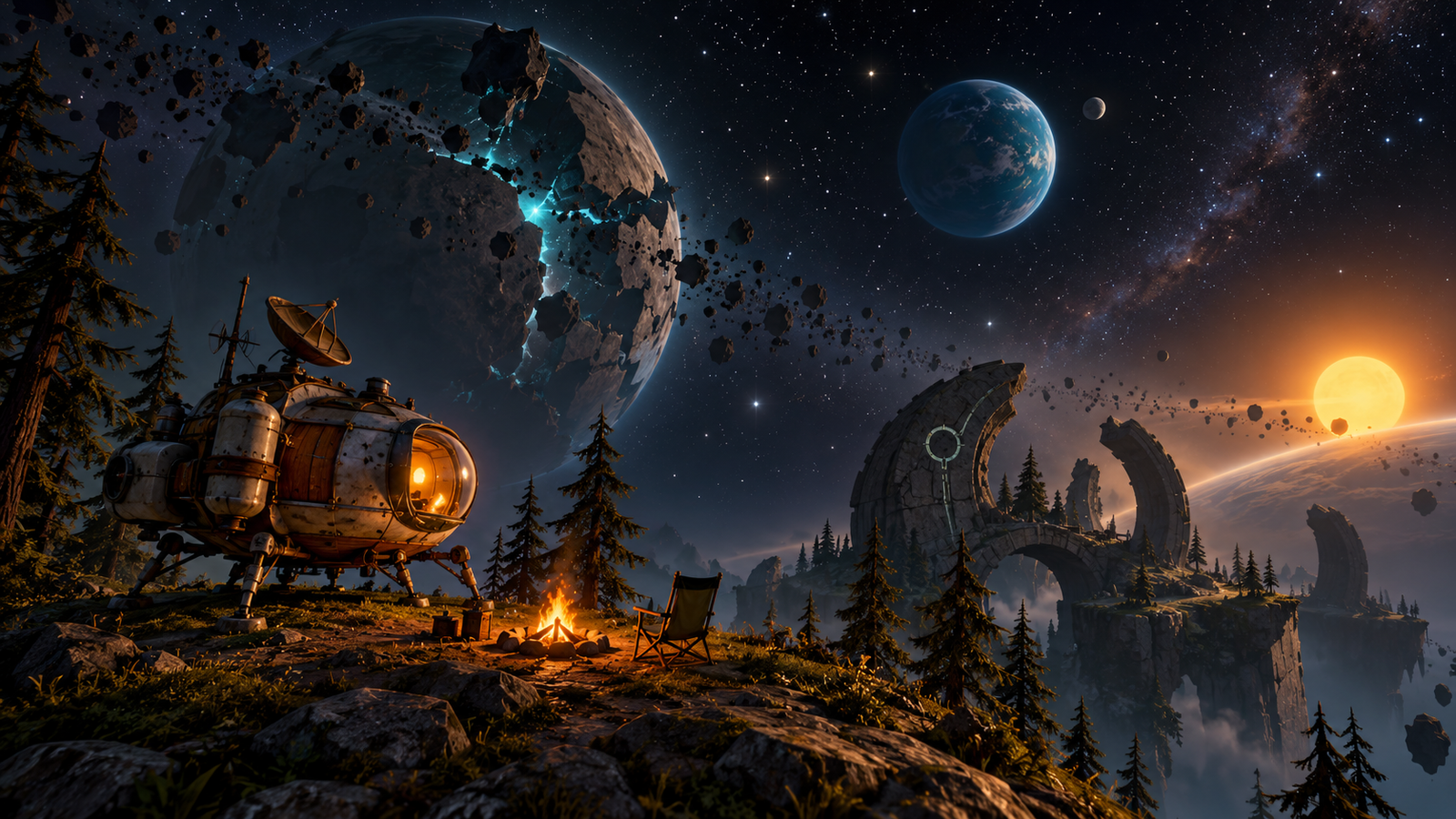
Outer Wilds is one of the most unique exploration games ever created. Developed by Mobius Digital, this critically acclaimed adventure takes players on a mysterious journey through a small solar system filled with ancient ruins, strange planets, hidden locations, and secrets waiting to be discovered. Unlike traditional adventure games, Outer Wilds does not rely on character levels, powerful weapons, or traditional quest markers. Instead, it encourages players to observe their surroundings, experiment with the environment, and use knowledge to uncover the truth behind an extraordinary cosmic mystery.
For beginners, the experience can initially feel confusing. You are given a spacecraft, a few exploration tools, and the freedom to travel between planets. However, the game rarely tells you exactly where to go or what to do next. You must investigate clues, interpret ancient writings, and connect discoveries to understand the larger story.
The game’s time-loop mechanic adds another layer of complexity. Events unfold according to a repeating cycle, meaning your exploration time is limited during each loop. However, your discoveries and knowledge remain valuable, allowing you to approach familiar locations with a better understanding of their secrets.
This beginner’s guide to Outer Wilds explains essential exploration techniques, spacecraft controls, useful tools, planetary mysteries, and strategies for making the most of every time loop. Whether you are just beginning your journey or struggling to understand the game’s interconnected clues, these tips will help you explore more effectively without spoiling its biggest revelations.
1. Understand How Outer Wilds Works
Before exploring the solar system, it is important to understand what makes Outer Wilds different from other adventure games.
Many games reward players with experience points, upgraded equipment, new abilities, or increasingly powerful weapons. Outer Wilds takes a different approach. Your character’s abilities remain relatively consistent throughout the adventure, and progress comes primarily from what you learn.
You might discover an ancient symbol on one planet, find a related structure on another, and eventually realize that both locations are connected to the same mystery. That knowledge can open new paths without requiring you to unlock an ability or defeat a powerful enemy.
Knowledge Is Your Most Important Resource
Treat every discovery as a potential piece of a larger puzzle. An unfamiliar building, unusual geological formation, or mysterious message may become important later.
You do not need to understand everything immediately. If a location contains information you cannot interpret, remember it and investigate other places. Another discovery may explain what previously seemed impossible to understand.
The game rewards curiosity, patience, and observation more than speed.
Explore at Your Own Pace
There is no single correct order for exploring every planet. You can follow an interesting signal, investigate an ancient ruin, or travel toward a mysterious object visible in the distance.
If you become stuck on one puzzle, move somewhere else. Exploring a different planet can provide the information you need to solve the original problem.
The freedom to choose your own direction is one of Outer Wilds’ greatest strengths.
2. Learn the Basics Before Leaving Timber Hearth
Your adventure begins on Timber Hearth, the home planet of the Hearthians. Before launching into space, spend some time exploring the village and becoming familiar with the world.
Speak with the characters you encounter. They provide useful background information, introduce important concepts, and help establish the setting.
Pay particular attention to the observatory and the equipment available before your first launch. These early interactions help you understand the solar system and prepare you for independent exploration.
Practice Using Your Equipment
Your signalscope, scout launcher, and spacesuit are essential exploration tools. Learning their functions early makes later discoveries much easier.
The signalscope helps identify and track signals from different sources. These may lead you toward characters, points of interest, or mysterious locations.
The scout launcher sends a small probe into the environment. You can use it to photograph distant objects, investigate dark spaces, and examine locations that are difficult to reach safely.
Your spacesuit provides oxygen and protects you during spacewalks. Monitor its resources and understand how to replenish oxygen when appropriate.
Spend a few minutes testing these tools in a safe environment. Familiarity with their controls will make challenging situations less frustrating.
3. Master Your Spaceship Controls
Your spacecraft is your primary method of traveling between planets. Although the controls may feel unfamiliar initially, learning how momentum works is essential for safe exploration.
Unlike vehicles in many action games, your ship operates in a low-gravity environment. When you accelerate, you continue moving until you apply thrust in the opposite direction.
This means that simply releasing the controls does not necessarily stop your movement.
Use Match Velocity
One of the most useful spacecraft functions is the ability to match velocity with a selected target.
When approaching a planet, moon, or other object, use the match-velocity function to reduce relative movement. This makes it easier to approach your destination without accidentally flying past it.
You can also use thrust in the opposite direction to slow down manually.
A useful beginner technique is to accelerate toward your destination, monitor your distance and speed, and begin slowing down before reaching it. With practice, you will develop a better sense of how far your ship travels.
Avoid Excessive Acceleration
Beginners often accelerate too aggressively because they want to reach destinations quickly. Unfortunately, this can make landing difficult.
Start with short bursts of thrust and observe how your ship responds. Gradually increase acceleration as you become more comfortable with the controls.
When approaching a planet, prioritize control over speed. A gentle landing is usually more useful than arriving quickly and crashing into the surface.
Learn to Land Carefully
Some planets contain uneven terrain, narrow openings, or locations that are difficult to reach from orbit.
Look for relatively flat landing areas whenever possible. Reduce your speed before approaching the surface, and use your ship’s camera to understand your position.
If a landing goes wrong, do not become discouraged. Accidents are part of learning how the game’s physics work.
Even experienced players occasionally make mistakes while navigating the solar system.
4. Use the Ship Log to Track Discoveries
The ship log is one of the most important tools available to beginners. It records information about locations, discoveries, characters, and mysteries you encounter during your adventure.
Because Outer Wilds rarely provides traditional quest markers, the ship log helps organize your investigation.
Understand Rumor Mode
Rumor Mode displays discoveries as an interconnected network of information. Different locations appear as connected entries, making it easier to identify relationships between clues.
For example, one entry might describe an ancient settlement, while another refers to a mysterious technology associated with that civilization. The connections can suggest where you should investigate next.
Look for entries marked as having more to explore. These indicate that you have visited a location but may not have discovered everything important there.
Review Your Log Frequently
Make checking the ship log a regular habit.
After visiting a new location, return to your ship and review the information you collected. You may notice a connection that was not obvious while exploring.
If you are unsure what to do next, inspect entries containing unanswered questions. They can provide a useful starting point for your next expedition.
The ship log is not merely a record of your progress. It is a practical guide to the game’s mysteries.
5. Explore Each Planet With a Purpose
The solar system contains several distinct environments, each offering different challenges and discoveries.
Rather than visiting a planet randomly and leaving immediately, choose a specific objective for each expedition.
You might investigate a signal, search for a particular structure, examine an unusual landmark, or follow information discovered elsewhere.
Having a goal makes exploration more productive without removing the freedom to investigate unexpected discoveries.
Timber Hearth
Timber Hearth is an excellent place to become comfortable with the game’s mechanics.
Explore the surrounding landscape, investigate locations mentioned by the villagers, and practice using your equipment. The planet offers a relatively accessible introduction to environmental exploration.
Attlerock
Attlerock, the moon orbiting Timber Hearth, is another useful destination for beginners.
It provides opportunities to practice flying between celestial bodies, landing on unfamiliar terrain, and investigating a small location away from your home planet.
Pay attention to signals and points of interest. Even seemingly minor discoveries can contribute to your understanding of the larger mystery.
Brittle Hollow
Brittle Hollow features unusual terrain and dangerous environmental conditions. Its unstable surface and enormous black hole make movement more challenging than on safer worlds.
Watch your surroundings carefully, and remember that the environment itself can change your available routes.
If you encounter a location that appears inaccessible, examine the surrounding structures and search for another approach rather than assuming that you need a special ability.
Giant’s Deep
Giant’s Deep is a water-covered planet with powerful storms and floating islands. Its environment introduces different challenges involving atmospheric movement and exploration.
Approach unfamiliar areas carefully, and use your equipment to investigate objects before committing to a risky maneuver.
If the conditions make progress difficult, consider exploring another destination and returning after learning more.
Ember Twin and Ash Twin
These neighboring planets are connected to important environmental and archaeological mysteries.
Their shifting landscape conditions and unusual structures reward observation and careful timing.
Look for patterns in the environment, examine ancient writings, and pay attention to how your surroundings change. Information discovered on one planet may help explain structures or events on the other.
You do not need to solve every mystery during your first visit. Recording discoveries and returning later is often the most effective strategy.
6. Make the Most of the Time Loop
Outer Wilds features a repeating time loop that fundamentally shapes exploration.
At first, the limited time available during each cycle may seem stressful. However, the loop is designed to encourage experimentation rather than punish every mistake.
Your character’s knowledge persists between loops, allowing you to build on earlier discoveries.
Set One Goal Per Loop
A common beginner mistake is attempting to accomplish too many objectives during a single cycle.
Instead, choose one main goal. You might want to reach a particular structure, investigate a mysterious signal, or determine how to enter a difficult location.
If you discover something unexpected along the way, investigate it when practical. However, maintaining a primary objective helps you use your time effectively.
Do Not Fear Failure
You will probably crash your ship, run out of oxygen, misjudge a jump, or arrive at a location too late.
These experiences are part of the learning process.
When a run ends unexpectedly, consider what you learned. Perhaps you discovered a new route, identified a dangerous environmental feature, or learned how a particular mechanism works.
A failed attempt can still provide valuable information.
Use Each Loop to Test Ideas
If you suspect that a particular structure behaves differently under certain conditions, use a new cycle to investigate.
Change one part of your approach and observe the result. This makes it easier to understand the relationship between your actions and the environment.
The time loop becomes much less intimidating once you begin treating it as an opportunity to experiment.
7. Use Your Scout Launcher Strategically
The scout launcher is more useful than it might initially appear. It can help you investigate dangerous or unfamiliar environments without immediately placing yourself at risk.
Photograph Difficult-to-Reach Areas
Some locations are dark, narrow, or difficult to inspect from your current position.
Launch your scout into these areas and use its camera to gather information. Photographs can reveal environmental details that are otherwise difficult to see.
You can also use the probe to inspect surfaces and determine whether a particular route is worth attempting.
Investigate Before Committing
Before entering a suspicious opening or approaching an unfamiliar structure, consider launching your scout first.
This is especially useful when you are unsure about the surrounding terrain.
The probe cannot solve every environmental challenge, but it can reduce uncertainty and help you make better decisions.
Follow Unusual Discoveries
If your scout reveals an interesting feature, take time to investigate it personally when safe.
A small visual detail might indicate a hidden entrance, an unusual structure, or a connection to another location.
Remember that the scout is an investigative tool. Its greatest value comes from helping you ask better questions about your surroundings.
8. Follow Signals and Listen Carefully
Sound is an important part of exploration in Outer Wilds. Several signals can guide you toward interesting locations and help you identify what is happening nearby.
Your signalscope allows you to identify certain sources and track their direction.
Scan Your Environment Regularly
When arriving on a new planet, use your signalscope to look for recognizable signals.
You may discover a distant character, a familiar musical source, or another point of interest that deserves investigation.
Signals can help you explore when visual landmarks are difficult to recognize.
Learn to Recognize Different Sounds
The game’s audio design communicates information about the environment.
Listen for changes in the sounds around you, especially when entering a new location or approaching an unfamiliar object.
Music, environmental noise, and signals can all help you understand your surroundings.
Headphones can make these details easier to notice, although they are not essential for enjoying the game.
9. Read Ancient Texts and Connect the Clues
Ancient writings are central to understanding Outer Wilds. Throughout the solar system, you will encounter messages left behind by an advanced civilization known as the Nomai.
These texts explain historical events, scientific experiments, personal conversations, and research projects.
Reading them carefully can reveal information about locations you have not yet visited.
Do Not Skip the Dialogue
It can be tempting to skim ancient messages when exploring several locations in succession. However, doing so may cause you to miss essential information.
Pay attention to names, locations, experiments, and questions raised by the Nomai.
A message might refer to a project that appears unrelated to your current destination. Later, you may discover that the two locations are directly connected.
Look for Repeated Terms
Repeated words and phrases often indicate important concepts.
If several messages mention the same device, location, or experiment, consider investigating the connection.
The ship log can help organize these relationships and remind you where particular clues originated.
Outer Wilds rewards players who treat information as evidence rather than background decoration.
10. Discover Hidden Secrets Through Observation
Many of the game’s most memorable discoveries come from noticing something unusual rather than following a clearly marked path.
A strange structure might appear decorative until you inspect it closely. A seemingly empty area might contain evidence of an important event. An unusual environmental pattern might reveal how to reach a previously inaccessible location.
Examine Unusual Structures
When you discover a building or ancient ruin, look beyond the most obvious entrance.
Check nearby pathways, unusual markings, and surrounding terrain. Investigate interactive objects and read any available text.
If a structure appears inaccessible, examine its surroundings for another route or a clue explaining its purpose.
Observe Environmental Changes
Some locations behave differently as time passes.
Structures may become accessible or inaccessible, terrain may shift, and environmental hazards may change your available routes.
If a location seems impossible to explore, consider whether timing is the missing piece.
Observe what happens around you before deciding that a puzzle is unsolvable.
Revisit Familiar Locations
Returning to a previously explored area is often worthwhile.
After learning new information elsewhere, you may recognize a detail that you previously overlooked. You might also understand the purpose of a structure that initially seemed meaningless.
Because knowledge drives progress, familiar locations can become more interesting as your understanding develops.
11. Manage Oxygen, Fuel, and Environmental Hazards
Exploration can become dangerous when you ignore your spacesuit’s resources or fail to recognize environmental hazards.
Your oxygen supply is particularly important during spacewalks and underwater exploration.
Monitor Oxygen Levels
Keep an eye on your oxygen supply whenever you leave your spacecraft.
If you discover an oxygen source, learn how to replenish your supply before continuing into a dangerous area.
Avoid taking unnecessary detours when oxygen is running low.
If you are unsure whether a distant location is reachable before your supply runs out, consider investigating it during a future loop.
Pay Attention to Fuel
Your spacesuit’s jetpack consumes fuel, and excessive use can leave you unable to maneuver effectively.
Use controlled bursts rather than holding the thrust controls continuously.
When exploring narrow passages or unfamiliar terrain, prioritize precise movement over speed.
Respect Environmental Hazards
Each planet has its own dangers. These can include unstable terrain, extreme weather, gravity-related challenges, and other environmental conditions.
Do not assume that a route is safe simply because it was accessible during an earlier visit.
Observe the environment, look for warning signs, and adapt your approach to the conditions.
12. What Beginners Should Avoid
A few common mistakes can make Outer Wilds more confusing than it needs to be.
Avoid expecting traditional quest markers. The game encourages independent investigation. Use your ship log, signalscope, and curiosity to decide where to go.
Do not rush through discoveries. Ancient texts and environmental details frequently contain information that becomes important later.
Avoid treating every obstacle as a combat challenge. Outer Wilds focuses on exploration, observation, and problem-solving rather than conventional combat progression.
Do not repeatedly attempt the same failed approach without reconsidering it. If a route seems impossible, search for additional clues or investigate another location.
Avoid worrying about completing everything immediately. You are not expected to understand the entire solar system during your first few loops.
Do not ignore the ship log. It is one of your best resources for organizing information and identifying unanswered questions.
Most importantly, avoid searching for solutions too quickly. Discovering how the pieces fit together is a major part of what makes the game special.
13. A Simple Exploration Strategy for New Players
If you are unsure how to begin, follow this straightforward approach.
Start by exploring Timber Hearth and learning how your equipment works. Speak with the villagers and investigate the locations that interest you.
Next, travel to the Attlerock and practice flying, landing, and using your signalscope. Become comfortable navigating between celestial bodies.
Once you understand the basics, choose another planet based on an interesting signal or a clue recorded in your ship log.
When you arrive, establish a clear objective. Investigate a structure, follow a signal, or search for information about a mystery you have already encountered.
After returning to your ship, review the ship log. Identify any new connections and note which questions remain unanswered.
Then choose your next destination based on what you learned.
This approach creates a natural exploration cycle: discover something, gather information, review the evidence, and use your new knowledge to investigate further.
As you become more familiar with the solar system, you will naturally begin connecting discoveries across multiple planets.
Conclusion
Outer Wilds is an extraordinary adventure that rewards curiosity, patience, and a willingness to experiment. Its solar system may initially feel confusing, but every discovery contributes to a larger understanding of the mysteries surrounding you.
For beginners, the most important skills are learning how to control your spacecraft, using the signalscope and scout launcher effectively, reading ancient texts, and reviewing the ship log regularly. Understanding the time loop also helps transform limited exploration time into an opportunity to test ideas and learn from mistakes.
Remember that you do not need to explore every planet in a specific order. Follow the clues that interest you, revisit locations when new information becomes available, and do not be afraid to change direction when a mystery becomes difficult.
Most importantly, give yourself the opportunity to experience the game’s discoveries firsthand. Avoid rushing toward solutions, pay attention to your surroundings, and allow seemingly unrelated clues to develop into a bigger picture.
The real reward in Outer Wilds is not collecting powerful equipment or defeating increasingly difficult enemies. It is understanding a mysterious universe through your own observations.
With these beginner tips, you will be better prepared to explore the solar system, uncover hidden secrets, and appreciate one of gaming’s most memorable exploration experiences.