Introduction
Some video games impress players with stunning graphics, explosive action, or enormous open worlds. Others capture attention through clever storytelling, unusual gameplay, and mysteries that demand genuine thought. Return of the Obra Dinn belongs firmly in the second category. Developed by Lucas Pope, this distinctive detective adventure transforms an ordinary investigation into an unforgettable puzzle-solving experience built around observation, deduction, and curiosity.
Originally released for PC in 2018 before arriving on additional platforms, Return of the Obra Dinn has earned recognition for its original presentation and remarkable investigative design. Instead of following a conventional detective through crime scenes, players become an insurance investigator examining a merchant ship that has mysteriously returned to port after disappearing for years.
The ship, known as the Obra Dinn, contains a disturbing history. Its crew members and passengers are either missing or dead, and the circumstances surrounding their disappearance remain unknown. Armed with a special pocket watch and a detailed ledger, players must reconstruct the ship’s final events and determine the identities and fates of everyone aboard.
The result is a detective game that respects the player’s intelligence. It rarely tells you what to think, and it does not rely on endless objective markers to guide your investigation. Instead, it encourages you to notice small details, connect seemingly unrelated events, and build conclusions from evidence.
In this review, we examine the gameplay, story, visual design, puzzles, difficulty, strengths, weaknesses, and overall value of Return of the Obra Dinn to determine why it remains a brilliant choice for fans of mystery and adventure games.
Story and Setting: A Ship Filled With Secrets
The story begins in 1807 when the Obra Dinn, an East India Company merchant vessel, unexpectedly arrives at port after being missing for several years. The ship is badly damaged, and its crew is nowhere to be found in any ordinary sense. The authorities need answers, particularly because the vessel and its cargo are connected to insurance claims.
You take the role of an insurance investigator sent to examine the ship. Your task is to document the fate of every person who sailed aboard it.
At first, the assignment appears straightforward. Inspect the ship, identify the people involved, and determine what happened. However, the investigation quickly reveals that the Obra Dinn’s history is far more complicated than a simple maritime disaster.
The vessel’s story unfolds through fragments of its past. Each discovery reveals another moment from the ship’s journey, introducing new characters, conflicts, accidents, and mysterious events. As you investigate, the narrative gradually develops into a much larger mystery involving the crew, passengers, and the extraordinary circumstances that contributed to the tragedy.
One of the game’s greatest strengths is how naturally its storytelling integrates with gameplay. There are no lengthy cinematic sequences explaining every event. Instead, players reconstruct the narrative themselves by examining evidence and interpreting what they see.
This approach makes every discovery meaningful. Learning the fate of a crew member is not merely checking off an objective; it is uncovering another piece of a complicated historical puzzle.
The atmosphere also deserves special recognition. The ship feels isolated, dangerous, and filled with unanswered questions. Empty corridors, damaged rooms, abandoned equipment, and the remains of past events create a powerful sense of unease without depending on constant jump scares.
For players who appreciate investigative storytelling, the Obra Dinn offers a compelling mystery that becomes more fascinating as the evidence accumulates.
Gameplay: Investigation Through Observation and Deduction
The central gameplay loop revolves around exploring the ship and identifying what happened to its inhabitants.
Unlike many adventure games, Return of the Obra Dinn does not provide a conventional list of suspects with obvious clues attached to each name. Instead, players must carefully examine scenes, recognize individuals, and use contextual information to determine their identities and circumstances.
Your investigation revolves around three major activities: exploring the ship, examining frozen moments from the past, and recording conclusions in your ledger.
Exploring the Obra Dinn
The ship serves as the game’s primary environment. Players can move through its various areas, including cabins, decks, storage spaces, and other sections connected to the vessel’s history.
Exploration is essential because the smallest environmental detail may become useful later. Clothing, equipment, personal belongings, uniforms, relationships between characters, and positions within the ship can all provide valuable clues.
The game encourages thorough investigation rather than rushing from one objective to another. You might initially overlook a person standing in the background or fail to notice an object that later becomes important.
Returning to previously explored locations is often worthwhile because new discoveries can change how you interpret earlier scenes.
This design creates a satisfying investigative rhythm. You are rarely solving a puzzle by following a single obvious clue. Instead, you gather information over time and gradually build a more complete understanding of the ship’s occupants.
The Mysterious Pocket Watch
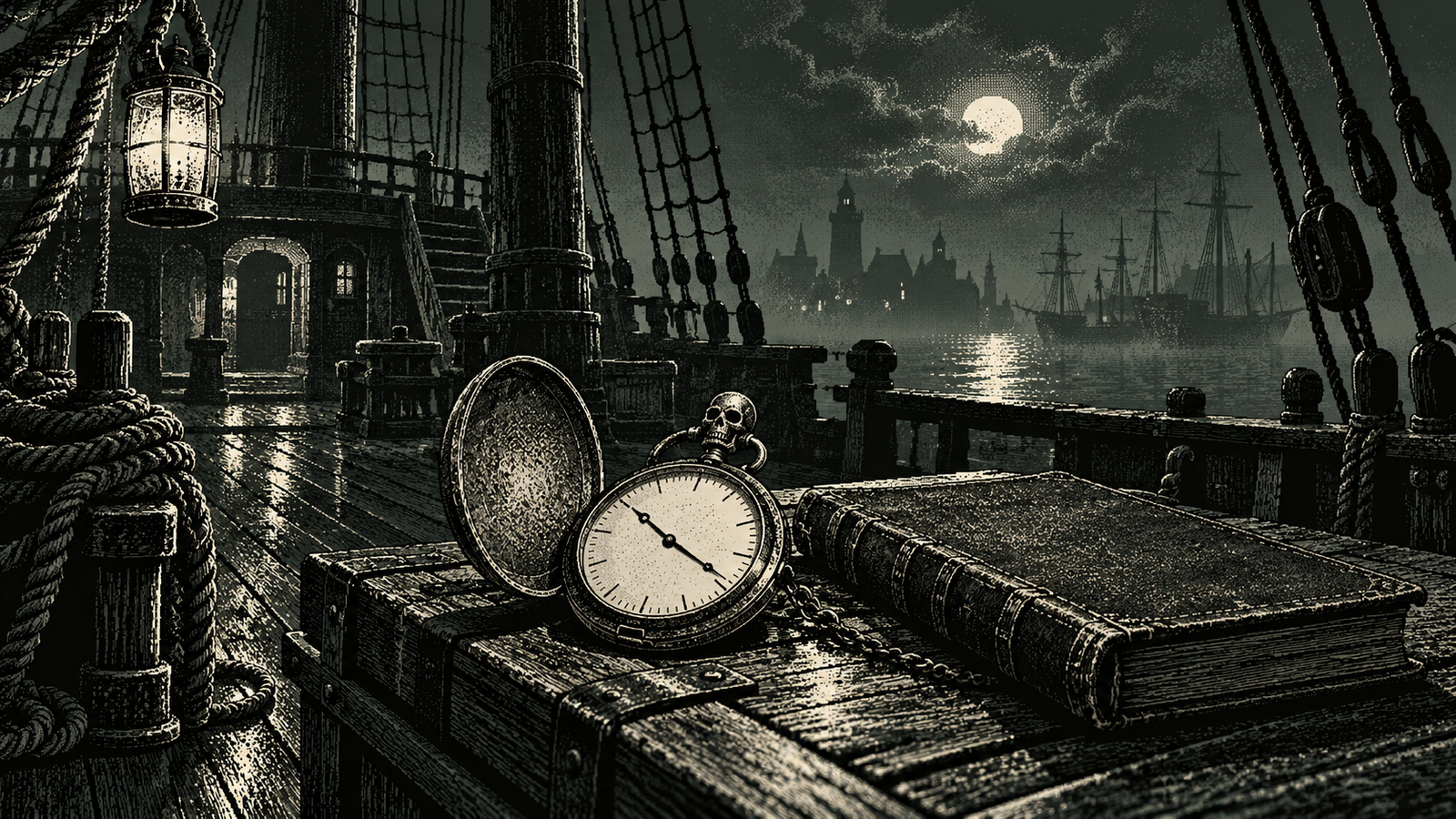
The pocket watch is one of the game’s most memorable mechanics. It allows you to examine the final moments of deceased individuals by transporting you into a frozen scene associated with their deaths.
When activated, the watch reveals a specific moment from the past. You can inspect the environment, listen to dialogue, and examine the positions of people involved in the event.
These scenes provide the essential evidence needed to reconstruct the Obra Dinn’s history.
Some moments are relatively straightforward. A person may be clearly visible in a familiar uniform, while another character’s actions reveal their involvement in an incident.
Other scenes are considerably more complicated. Several people may appear together, characters might be partially obscured, and dialogue may provide only indirect information about their identities or relationships.
The pocket watch transforms death scenes into interactive crime-scene reconstructions. Rather than simply presenting information through text, the game asks you to investigate the moment and interpret the available evidence.
This mechanic is central to the experience and remains one of the most inventive ideas in detective adventure games.
The Ledger: Your Most Important Investigative Tool
The ledger functions as the player’s central database. It contains a manifest of the ship’s crew and passengers, along with illustrations, names, positions, and spaces where their identities and fates must be recorded.
Initially, the ledger can feel intimidating because you may recognize very few people. However, as you investigate additional scenes, your understanding gradually improves.
You begin identifying individuals through their appearance, clothing, accents, jobs, relationships, and interactions with other characters.
The challenge is that no single source of evidence necessarily provides a complete answer. You might identify a person’s occupation from their uniform, recognize their nationality through dialogue, and establish their identity by comparing their appearance across multiple scenes.
The ledger rewards this combination of observation and logical reasoning.
It also helps players track progress. As you record information, the game confirms certain groups of deductions when enough answers are correct. This system offers reassurance without revealing every remaining solution.
The absence of constant hints is particularly effective. Instead of telling you exactly which person you have misunderstood, the game encourages you to revisit the evidence and reconsider your assumptions.
For players who enjoy keeping notes and organizing information, the ledger becomes an essential part of the experience rather than a simple menu.
Puzzle Design: Challenging but Fair
Puzzle-solving is the heart of Return of the Obra Dinn. Every major discovery contributes to the broader challenge of identifying the people aboard the ship and determining their fates.
The puzzles are unusual because they rely less on traditional adventure-game conventions and more on logical deduction.
You will not spend most of your time searching for colored keys or activating switches. Instead, you will examine human behavior, environmental clues, dialogue, and relationships.
For example, identifying a character might require you to notice their position in a group, determine their occupation, and connect them with someone mentioned in another scene.
Another investigation might depend on understanding what happened during a violent encounter. The scene reveals the immediate circumstances, but you must interpret the available evidence to establish the precise outcome.
The game frequently encourages players to make connections across different moments in the ship’s history. An apparently unimportant detail from an early scene may become crucial much later.
This interconnected structure makes solving the mystery deeply satisfying.
Why the Puzzles Work
The strongest puzzles provide enough information to support a conclusion without making the answer immediately obvious.
When you finally identify someone correctly, the discovery often feels earned. You can explain why the conclusion makes sense rather than simply recognizing a pattern or guessing randomly.
The game also benefits from its relatively limited environment. Because the ship is the central setting, players become familiar with its layout and can concentrate on understanding the events rather than constantly learning new locations.
However, the difficulty can become frustrating when several characters look similar or when the available clues seem too vague.
Players who prefer explicit instructions may find the investigative freedom challenging. The game expects patience and careful observation, and progress can occasionally slow when an important connection remains unclear.
Nevertheless, these difficulties generally support the central experience rather than undermine it. The satisfaction of solving a difficult deduction is one of the game’s greatest rewards.
Visual Design: A Distinctive Monochrome Experience
One of the most recognizable aspects of Return of the Obra Dinn is its unusual visual presentation.
The game uses a monochrome, low-resolution graphical style inspired by early computer graphics and historical visual technology. Rather than pursuing realistic textures or modern cinematic effects, it deliberately embraces a restricted palette and sharply defined shapes.
At first glance, the presentation may appear simple. However, the visual style is carefully integrated into the investigative mechanics.
Characters, objects, and environmental details are represented through distinctive patterns of light and shadow. Players must learn to interpret these visual clues, much as they must learn to interpret dialogue and behavior.
The result is an experience that looks unlike most contemporary adventure games.
The monochrome aesthetic also strengthens the atmosphere. The ship’s corridors and cabins feel strangely preserved, as though the player is examining fragments of an old photograph or a forgotten historical record.
Because the game does not rely on elaborate visual effects, attention remains focused on the evidence.
Some players may find the graphics difficult to read initially, particularly when several characters overlap or when environmental details are obscured by the limited visual palette. However, the presentation becomes easier to appreciate as players grow accustomed to its distinctive style.
The graphics are not simply a nostalgic gimmick. They help establish the game’s identity and reinforce its central theme of reconstructing the past from incomplete evidence.
Sound Design and Music
Sound plays a crucial role in making the Obra Dinn feel like a real place filled with people and history.
Dialogue, environmental audio, and carefully selected musical cues help establish the emotional character of individual scenes.
When the pocket watch transports you into a frozen moment, conversations and sounds provide additional context. A short exchange between two characters may reveal their relationship, occupation, nationality, or involvement in a particular event.
These details often matter as much as the visual evidence.
The audio design also contributes to the atmosphere. The ship’s setting feels isolated and unsettling, while the soundscape reinforces the seriousness of the investigation.
Music is used selectively rather than constantly dominating the experience. This restraint allows important moments to stand out and gives discoveries a greater emotional impact.
The combination of sound and visual presentation makes the investigation feel like an examination of a historical tragedy rather than an ordinary puzzle challenge.
Character Identification and Storytelling
Although the player investigates dozens of people, the game does not depend on conventional character development.
Instead, individuals become recognizable through their actions, relationships, dialogue, and positions within the ship’s social structure.
A sailor’s uniform might suggest their occupation, while the way another person addresses them could reveal a relationship or rank. Repeated appearances help players connect these observations and establish identities.
This system creates an unusual form of storytelling. Characters are not necessarily introduced through lengthy biographies or detailed conversations. Their identities emerge from the player’s own investigative work.
The more scenes you examine, the clearer the ship’s social structure becomes.
You begin to recognize patterns in how people interact and understand how particular relationships influence the events unfolding around them.
The experience also encourages players to consider the difference between observing an event and understanding it. Seeing someone in a dangerous situation does not automatically explain how they arrived there or why they became involved.
That distinction is central to the game’s detective premise.
Rather than simply delivering a story, Return of the Obra Dinn asks players to become active participants in constructing it.
Difficulty and Accessibility for New Players
Return of the Obra Dinn is approachable in its basic controls but demanding in its reasoning requirements.
Movement and interaction are relatively simple, allowing players to concentrate on exploration and deduction. The real challenge lies in processing information and deciding which conclusions are justified.
New players should expect moments when progress slows considerably. This is normal, particularly when investigating groups of characters whose identities are not immediately clear.
A few practical strategies can make the experience more enjoyable.
First, examine every scene carefully. Pay attention to people in the background, objects near the edges of the environment, and details that initially seem unimportant.
Second, listen to dialogue. Names, accents, job descriptions, and references to other characters can provide valuable clues.
Third, compare scenes rather than treating each one as an isolated puzzle. The identity of someone in one moment may become clear only after seeing them elsewhere.
Fourth, avoid filling every blank immediately. An uncertain guess can create confusion later, so it is often better to wait until the evidence supports a conclusion.
Finally, use the ledger to organize your findings. Tracking confirmed identities and possible relationships can make complicated investigations easier to manage.
The game does not always provide the kind of accessibility support found in modern mainstream releases. Its visual presentation may also require an adjustment period.
However, players who enjoy methodical problem-solving will find that its demanding approach creates a rewarding experience.
Strengths and Weaknesses
Like any game, Return of the Obra Dinn has limitations, even though its central design is remarkably strong.
What the Game Does Best
Original detective mechanics: The pocket watch, frozen scenes, and ledger create an investigative system that feels genuinely different from conventional adventure games.
Rewarding deduction: Solutions emerge from evidence and logical reasoning, giving successful discoveries a strong sense of accomplishment.
Memorable atmosphere: The ship’s unsettling environment, monochrome graphics, and sound design create a distinctive identity.
Integrated storytelling: Narrative discoveries and puzzle-solving reinforce each other instead of feeling like separate activities.
Respect for player intelligence: The game trusts players to investigate independently without constantly explaining every detail.
Excellent replay value for mystery fans: Although the central mystery is designed around discovery, revisiting scenes can help players understand overlooked details and appreciate how the clues fit together.
Where the Game Falls Short
Occasional ambiguity: Some deductions can feel difficult when evidence is subtle or several interpretations appear plausible.
A demanding learning curve: Players unfamiliar with investigative games may struggle to understand how to organize information effectively.
Repetitive investigative actions: Revisiting scenes and comparing characters can occasionally become tedious during longer sessions.
Limited visual appeal for some players: The deliberate monochrome style will not suit everyone, particularly those who prefer detailed modern graphics.
Minimal conventional action: Players expecting combat, platforming, or frequent action sequences may find the gameplay too restrained.
These weaknesses are worth considering, but they do not substantially diminish the game’s achievements. Its design is focused on a particular type of player, and it succeeds remarkably well at delivering that experience.
Is Return of the Obra Dinn Worth Playing in 2026?
Yes. Return of the Obra Dinn remains an excellent recommendation in 2026 for players who appreciate mystery, deduction, and unconventional adventure games.
Its greatest advantage is that its central mechanics do not depend on contemporary graphics technology or temporary gameplay trends. The experience remains compelling because its puzzles are built around observation and reasoning.
Players who enjoy detective stories, escape-room challenges, historical mysteries, or games that require careful attention will find plenty to appreciate.
It is also an excellent choice for people who feel overwhelmed by games filled with map markers, quest notifications, and constant instructions. Here, progress comes from understanding the evidence rather than following a checklist.
However, the game is not an ideal recommendation for everyone.
Players who prefer fast-paced combat, extensive character customization, or large open worlds may find the experience too slow. Those who dislike difficult puzzles may also struggle with its deliberate pace.
The best way to approach the game is with patience and curiosity. Allow yourself time to inspect scenes, compare details, and reconsider assumptions.
For the most suitable players, the experience offers something increasingly distinctive: the pleasure of solving a mystery through personal reasoning.
Availability, pricing, and platform support can vary by store and region, so players should check their preferred digital storefront before purchasing.
Final Verdict
Return of the Obra Dinn is a brilliant detective puzzle adventure that demonstrates how powerful an original gameplay concept can be.
Its story of a missing merchant ship provides the foundation for an intricate investigation, while the pocket watch and ledger transform that investigation into a deeply interactive experience.
The monochrome visuals create an unforgettable atmosphere, the sound design strengthens the storytelling, and the puzzles reward players who pay attention to even the smallest details.
The game is not without its challenges. Some deductions can be frustrating, the presentation may require adjustment, and the slow investigative pace will not appeal to every player. Nevertheless, these characteristics are closely connected to what makes the experience special.
Rather than giving players easy answers, Return of the Obra Dinn asks them to think critically, recognize patterns, and reconstruct events from incomplete information.
Final Rating: 9.5/10
Verdict: Highly recommended for fans of detective adventures, mystery games, and intelligent puzzle design.
If you are looking for an adventure that challenges your reasoning instead of your reflexes, Return of the Obra Dinn deserves a place on your gaming list in 2026. Its unusual presentation and demanding investigation make it one of the most memorable puzzle adventures available to players who value creativity and meaningful discovery.